
Brazil 🇧🇷
Posted September 13, 2026 🇧🇷


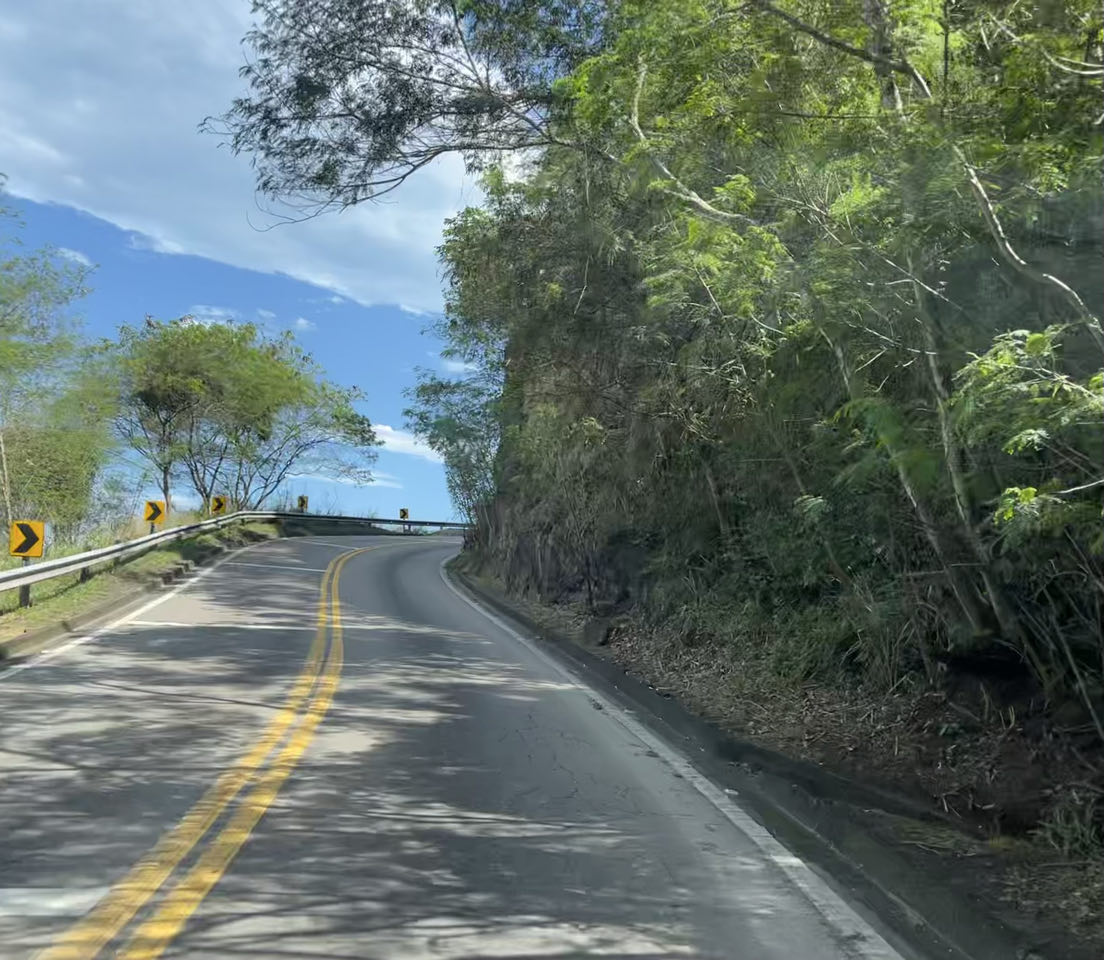
After two nights in Riviera de São Lourenço, we leave our spot because it’s raining nonstop. We also decide to take the slightly better-maintained BR160/BR021 via São Paulo to reach the BR116. We’re doing this because reports of flooding and blocked roads are increasing. Even on this route, we encounter the incredible natural beauty that characterizes this coast. However, it’s raining constantly again today, and the decision to take the better-maintained roads was certainly the right one. Today, we climb again from sea level to nearly 800 meters up to São Paulo, which we bypass, though. And soon we’re on the “notoriously infamous” BR-116, the Rodovia Régis Bittencourt—or, as it’s also known, the Rodovia da Morte. In the 1980s and 1990s, this stretch was statistically one of the most dangerous roads in the world. The reasons for the extremely high fatality rate lay in a deadly combination of geography, poor infrastructure, and traffic congestion. At its peak (especially in the 1990s), between 200 and 300 people died on this stretch of road each year. For example, a single serious bus accident in December 1993 claimed 41 lives in one fell swoop. After decades of delays due to environmental and budgetary concerns, the four-lane expansion of the infamous mountain route was fully completed at the end of 2017. Thanks to separated lanes, modern tunnels, and emergency lanes, the number of serious head-on collisions has dropped dramatically, which is why the term “Rodovia da Morte” is now primarily a historical nickname for this section. We’ll cover the first, short section today, and spread the rest out over the next few days, taking it easy.
Cachoeira De Cima, September 14, 2026 🇧🇷


Finally, the sun is out again, and everything already looks so much nicer! We’ll take our time covering the remaining kilometers to Curitiba, spending two more nights at truck stops. The road continues to demand our full attention; the potholes show no sign of letting up, and the extent of the heavy rainfall is clearly visible along the route. Around noon on Tuesday, we arrive just outside Curitiba, where we’ll spend one more night before heading to the Mercedes garage on Wednesday.
Curitiba, September 17, 2026 🇧🇷


Curitiba, the city of capybaras! The best thing to do is take a stroll through Parque Barigui and enjoy the scenery… But first, there are a few things to take care of. Our first stop is at Savana, the local Mercedes dealership in Atuba/Curitiba. Here, we get an oil change, an oil filter change, and a fuel filter change. Everything is done very professionally, and at the equivalent of CHF 450, it’s also a very fair price. By late afternoon, everything is taken care of, and we head to our campsite for the next few days. Just outside downtown Curitiba is the So Trailers campground—not very large but very secure. It’s family-run and also serves as a RV repair shop that handles customizations and repairs. They also carry accessories, and if something is missing, they’ll order it with no hassle. We spend our first day visiting the Jardim Botânico Municipal de Curitiba. The park is the city’s most famous landmark and is considered one of the most beautiful places in Brazil. The park opened in 1991 and covers an area of approximately 240,000 square meters. The Art Nouveau-style main greenhouse, with its three striking domes, is the centerpiece of the park. The metal-and-glass structure was inspired by the 19th-century Crystal Palace in London. Inside, numerous tropical plant species from the Atlantic Rainforest thrive. The path to the greenhouse winds through geometrically laid-out, perfectly manicured flower beds and fountain complexes modeled after classic French gardens. The layout of the gardens is based on the flag of Curitiba. Directly behind the greenhouse is a U-shaped space where exhibitions are held, accompanied by the music of Vivaldi. The gallery is also equipped with hundreds of solar panels that generate a large portion of the park’s energy. And of course, there’s a nice coffee shop that invites you to linger. However, it’s not exactly warm today, so sitting outside isn’t really an option, but a visit to the park is a must when you’re in Curitiba.
Curitiba, September 18, 2026 🇧🇷


Our campsite is firmly in the “hands” of the poultry, which also calls the shots. If you’re not too keen on being woken up for the first time between 3 and 4 a.m., you’d better find another spot… The numerous roosters and hens are very curious, and every open door is an invitation. The cute parrots, dogs, cats, etc., all have to wait their turn. We’re “escaping” the poultry, because today we’re heading to Dagostin, where we’ll get new tires. Our tire size (215/85R16) isn’t very common in Brazil, but with a bit of luck, we found four Hankook Dynapro AT2 tires. They’ll be installed today, and then we should be ready for our trip south. Since our BJ is a bit too big for the shop, everything is done out front. The staff is very friendly, and at the end, we even take some photos for Dagostin’s Instagram page. Next stop is the hair salon for Adriana—everyone needs that every now and then. And on the way home, we’ll swing by the Só Trailers camper shop, where we’ll order a windshield repair kit—a small but valuable accessory for our continued journey south.
Curitiba, September 19, 2026 🇧🇷


Since we’re already in Curitiba, we’re making the most of our time and checking out a few sights. We start the day with the Museu Oscar Niemeyer, or simply MON. Its most striking feature is the futuristic, eye-shaped extension made of glass and concrete, which seems to float weightlessly on a colorful, 21-meter-high pillar above a water basin.
The world-famous Brazilian architect Oscar Niemeyer originally designed the main building back in 1967 (at that time as an educational institute). Decades later, he designed the iconic eye-shaped addition. When the entire complex was officially opened in 2002, Niemeyer was a proud 95 years old! It is a living testament to his philosophy that sweeping, sensual curves are far more beautiful than rigid, straight lines. With an area of 35,000 square meters, it is the largest art museum in Latin America and has already been named one of the 20 most beautiful museums in the world by the U.S. magazine Flavorwire. And here’s a tip: The coffee at the museum comes highly recommended!
We continue toward the city center—on foot, of course… because it’s raining. We walk along Rua XV de Novembro, the “Rua das Flores.” In the early 1970s, the street was a completely congested, car-dominated thoroughfare. The visionary mayor, Jaime Lerner, wanted to transform it into Brazil’s first exclusively pedestrian-only zone. Shop owners protested vehemently because they feared a drop in sales. Lerner’s ingenious solution: He had the street secretly cordoned off one Friday evening in May 1972. Within just 48 hours, workers tore up the cobblestones, laid tiles, built flower beds, and installed lighting. When the shopkeepers arrived on Monday morning, the street was car-free and full of people strolling about. A radical move that made urban planning history! Shortly after the opening on that Monday, angry drivers threatened to break through the barriers and reclaim the street. Mayor Lerner reacted in a flash with a disarming idea: He rolled out huge sheets of paper on the ground and invited hundreds of schoolchildren to paint with watercolors right in the middle of the street. No driver dared to run over the children as they painted. The protest turned into a celebration. This tradition lives on to this day: Every Saturday morning, a section of the street is reserved for children to paint. Today, the street is lined with beautifully restored Art Nouveau facades, countless flower pots, and talented street performers. In the early afternoon, however, the sky opens up and we take refuge in the nearest restaurant, where we spend the rest of the afternoon.
Curitiba, September 21, 2026 🇧🇷


If you’re looking for parks, Curitiba is the place to be. And it seems as though each of these parks is trying to outdo the others. Take Tingui Park, for example: right in the middle of the park stands a beautiful Byzantine church built entirely of wood. It’s a faithful replica of the Igreja de São Miguel in Mallet (Paraná)—the oldest Ukrainian church in Brazil. The park itself is very spacious and winds largely through jungle, which is a real relief, especially in hot weather.
Or Parque Tanguá: Where people now jog and take photos, there were two huge quarries (pedreiras) owned by the Gava family until the 1970s. In the 1990s, the abandoned, deeply scarred site was actually slated to be converted into an industrial waste and recycling landfill. At the last moment, the city changed its mind, completely reimagined the site, and opened Parque Tanguá in 1996 as a prime example of urban sustainability. The garden adjoins a steep cliff. From the top, an artificial, 65-meter-high waterfall plunges into the lake below. The interplay between European castle garden architecture and the rugged, vertical rock face is a stunning sight.
Another recommendation is the Passeio Público in downtown Curitiba: Founded in 1886 by the then-provincial governor Alfredo d’Escragnolle Taunay, the Passeio Público is Curitiba’s first public park and its first large green space. Before the park was created, the site was a wild, marshy area along the Rio Belém. Its drainage and transformation were a groundbreaking masterpiece that laid the foundation for Curitiba’s identity as Brazil’s “green capital.” For decades, the Passeio Público was home to Curitiba’s very first zoo. Today, the area has transformed into a fascinating sanctuary. It serves as a center for bird conservation and species protection, where injured animals are cared for and endangered species are bred. Here we stroll among magnificent macaws, herons, and colorful, exotic birds that have found an oasis in the middle of the urban jungle.
And to top it all off, there’s the Ópera de Arame: Architect Domingos Bongestabs designed this visionary, circular theater made of steel tubes and transparent polycarbonate. The crazy thing is: The entire structure, weighing 360 metric tons, was built from the ground up in a record-breaking 75 days and opened on March 18, 1992! Because the delicate, white metal tubes look like a fine wire mesh from a distance, the locals affectionately dubbed it the “Wire Opera.” Like the Tanguá and Tinguí parks, the Ópera de Arame is a testament to Curitiba’s ingenious eco-recycling. It was built in the middle of the rugged basin of a former, abandoned quarry (Parque das Pedreiras). Today, the theater floats on pillars in the middle of an artificial lake and is accessible only via a suspended pedestrian bridge. Directly behind the stage, a dramatic waterfall plunges down the steep rock face—pure natural theater! A permanent music festival takes place here under the name Vale da Música. On a small, floating stage right on the lake, different live bands perform instrumental music daily from Tuesday through Sunday—ranging from jazz and bossa nova to classic rock. So you can drop by even without a fancy opera ticket, stop by the beautiful basement restaurant Opera Arte, enjoy a cold beer, and listen to the music. The rest of the grounds feature a variety of permanent exhibitions, several restaurants, and live music to enjoy.
Leave a Reply